> ## Documentation Index
> Fetch the complete documentation index at: https://www.diadata.org/docs/llms.txt
> Use this file to discover all available pages before exploring further.
# Fundamental Feeds
> Derive asset values from their fundamentals rather than market prices. Ideal for stablecoins, synthetic assets, and yield-bearing tokens.
Fundamental Feeds provide an alternative to market-based pricing by calculating an asset's value directly from its fundamentals. Instead of relying on exchange trades or liquidity-driven mechanisms, these feeds derive price from objective on-chain or off-chain proofs of collateral, redemption logic, and reserve holdings.
This makes them particularly relevant for synthetic assets, stablecoins, yield-bearing tokens, and structured vaults.
# Features
* Independent of market volatility or liquidity distortions.
* Transparent methodology based on verifiable reserves, liabilities, and contract logic.
* Applicable across DeFi instruments ranging from liquid staking tokens to stablecoins and vaults.
# Methodologies
## Contract Exchange Rate
For tokens with built-in exchange logic (e.g. stETH, aUSDC, cDAI), price is calculated from the ratio of underlying assets to total shares:
$$
exchangeRate = totalUnderlying / totalShares
$$
**Use case:** Price liquid staking and yield-bearing tokens from their on-chain exchange rate, so lending markets value them by what they redeem for rather than thin DEX prices.
## Reserve-Backing
For collateral-backed assets, reserves are divided by circulating supply to produce a backing-based fundamental value:
$$
fundamentalPrice = reserves / supply
$$
Reserves may consist of multiple assets held across wallets.
**Use case:** Value collateral-backed stablecoins and wrapped assets by their verified reserve backing, giving vaults a manipulation-resistant collateral price.
### Redemption-Capped Valuation
Many collateral-backed tokens, particularly stablecoins and over-collateralized synthetic assets, include protocol-level redemption mechanisms that cap the redeemable value per token. For these tokens, the fundamental price is calculated as:
$$
fundamentalPrice = min(reserves / supply, 1) \times redeemableValuePerToken
$$
**Use case:** Cap an over-collateralized stablecoin or synthetic asset at its redeemable value, preventing overvaluation when the market price rises above par.
## Net Asset Value (NAV)
For vault-based tokens, price equals the value of assets minus liabilities, divided by outstanding tokens:
$$
fundamentalPrice = (assets - liabilities) / totalSupply
$$
**Use case:** Price tokenized funds, vaults, and structured products from their real-time NAV, so share tokens track the value of the underlying portfolio.
## Redemption Value
For mint/burn models, the fundamental value corresponds to the amount of underlying assets received when redeeming one token. This is typically retrievable directly from the redemption contract.
**Use case:** Price mint/burn assets at their on-chain redemption value. This is ideal for wrapped tokens and 1:1 redeemable instruments.
## Proof of Reserves
For custodial or synthetic assets, feeds can publish the total value of reserves as reported by verified custodians or proof-of-reserve attestations:
$$
reserveValue = \sum_{i=1}^{n} (reserves_i \times price_i)
$$
**Use case:** Publish verified reserve value for custodial or wrapped assets, letting protocols confirm backing and automate risk logic (e.g. pausing on under-collateralization).
# Architecture Flow Overview
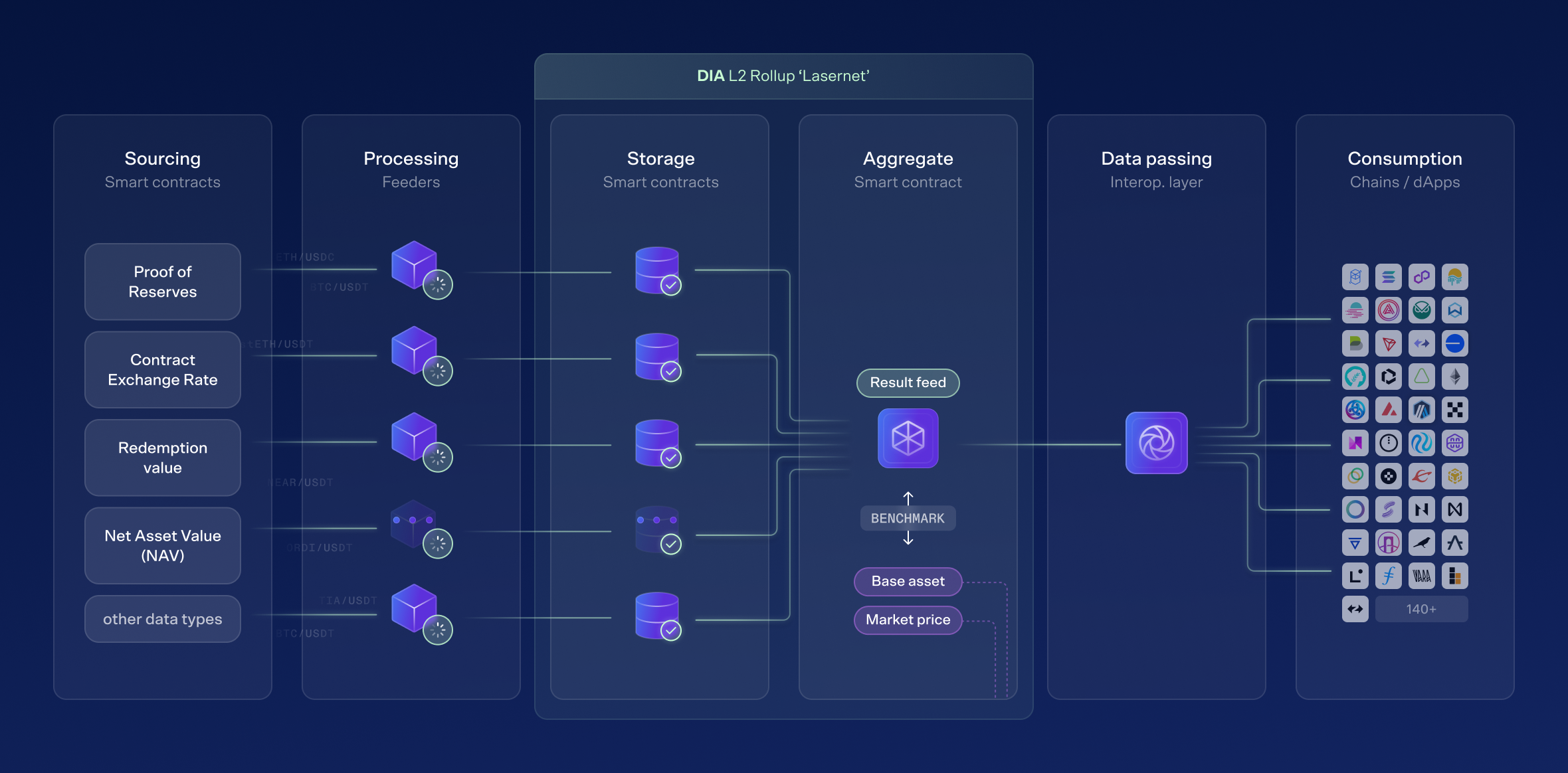 * Each feeder is pulling balance sheets (reserves, supply).
* Lasernet is the ledger where all feeders submit their reports.
* The aggregator contract is consolidating those reports into one official number.
* The messaging layer is delivering that number to every chain where it's needed.
* Protocols then rely on this official number to decide risk and operations.
# Developer Notes
Fundamental Feeds can operate alongside traditional market price feeds. Protocols can consume both sources to implement safeguards such as:
* Depeg monitoring (triggering alerts if fundamental value diverges from market price).
* Fallback mechanisms to fundamental pricing when market feeds become unreliable.
* Enhanced transparency by exposing raw inputs such as reserve addresses or contract state.
If you're interested in integrating Fundamental Feeds into your project, request a custom oracle below:
* Each feeder is pulling balance sheets (reserves, supply).
* Lasernet is the ledger where all feeders submit their reports.
* The aggregator contract is consolidating those reports into one official number.
* The messaging layer is delivering that number to every chain where it's needed.
* Protocols then rely on this official number to decide risk and operations.
# Developer Notes
Fundamental Feeds can operate alongside traditional market price feeds. Protocols can consume both sources to implement safeguards such as:
* Depeg monitoring (triggering alerts if fundamental value diverges from market price).
* Fallback mechanisms to fundamental pricing when market feeds become unreliable.
* Enhanced transparency by exposing raw inputs such as reserve addresses or contract state.
If you're interested in integrating Fundamental Feeds into your project, request a custom oracle below: